
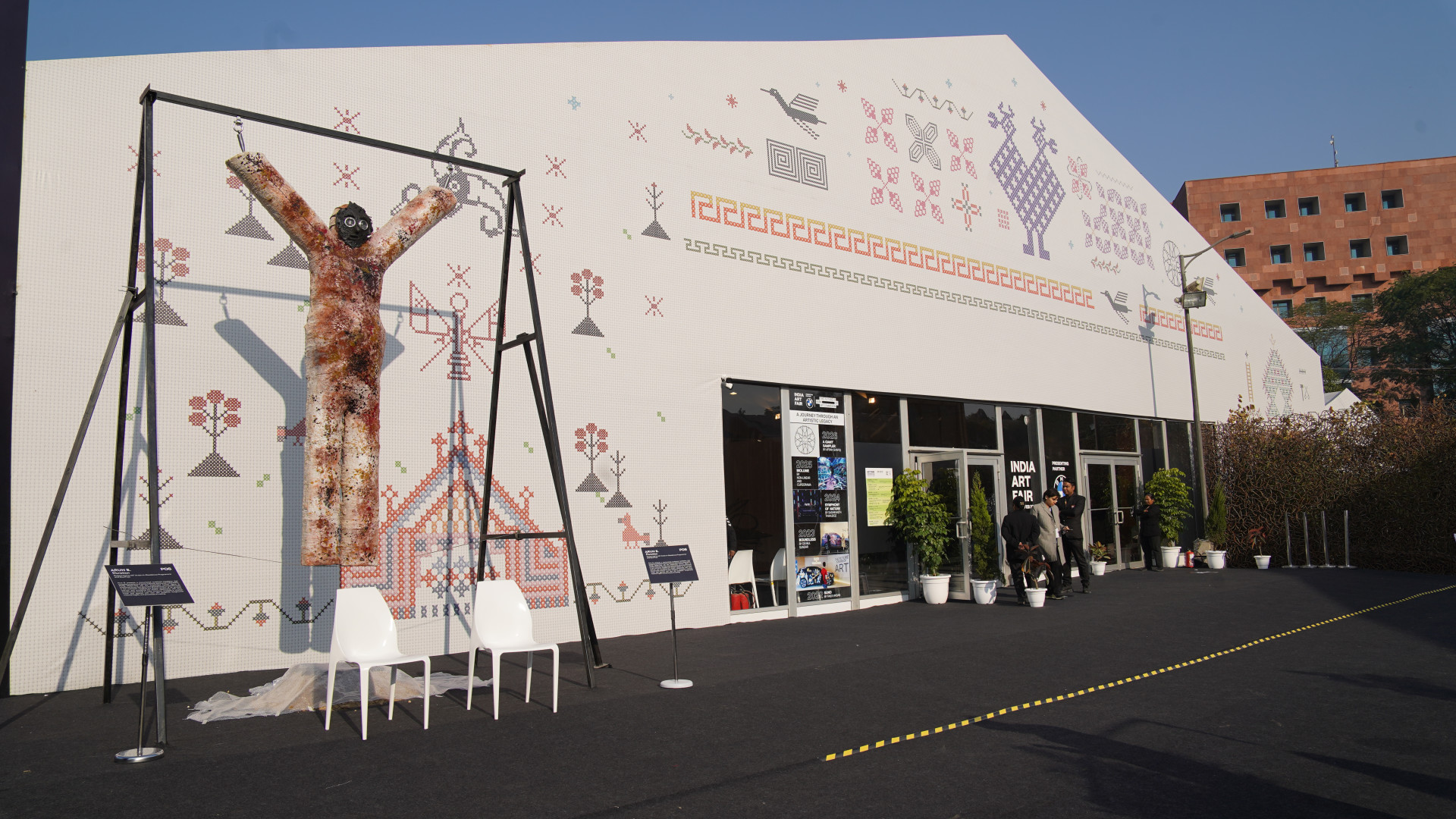
In a world where women’s labour largely remains invisible, artist Afrah Shafiq reimagines the humble sampler, an often hidden piece of cloth used by countless women to practice embroidery patterns, as a way to record and map embroidery traditions, arithmetic logic, and coded languages embedded in motifs across time and cultures, in a deeply personal act of gathering.
Working across hybrid forms that bring together text, sound, code and animation, Afrah’s practice seeks to retain the tactile within the digital and the poetry within technology. From st.itch (2017), which examined women’s domestic labour through a multimedia patchwork cum QR code, to her 2024 video game The Bride Who Could Not Stop Crying, rooted in Slavic folk embroidery traditions, Shafiq has returned constantly to needlework as computational system and coded text, as a way to examine power structures, societal frameworks, and gendered spaces. “Through this game I began to see embroidery as text that can be read, and motifs as a language of their own, embedded within incredibly complex and rich meanings.”
This interest in building “archives that one wishes existed” sits at the core of her practice. She has long worked at the intersection of the physical and digital, creating spaces where material culture and code coexist.
We arrive at Shafiq’s studio, a freshly painted white and red duplex in a small gated community that was once imagined as a group of Airbnb homes built around an oddly shaped pool, now out of commission, filled halfway with green mossy water and graffiti that dishes out bite-sized philosophies: “We’ve Lost Dancing”, “Where Is The Will To Be”. A red-laterite staircase leads us up to a hand-painted phool patti sign that reads “Love & Other Outdoor Games”, the same as the artist’s online tag. Inside, a large hall and a smaller room connected by a short passage feel open; slanted light streams in, catching the red oxide floor and the stained glass mosaics Shafiq is working on. Books on craft practices, algorithmic thinking, parenting, pattern sit alongside small containers of material from past and current projects. In the corridor, a geographically expansive collection of Mother Mary figurines echoes the Goan landscape punctuated by grottos and shrines. In the smaller room, Shafiq pulls up early mockups of the facade on her computer, then quickly animates a small pixelated device nearby to show us in real time what people would see when they scanned the motifs on their phones. A whiteboard lists projects underway, pending tasks, upcoming deadlines. Pin-up references of textile traditions, images of patterns, find place on the walls of both rooms, alongside letters from family and friends, prompts and instructions by Dzongsar Khyentse Rinpoche, photographs of Shafiq as a child, a polaroid of her daughter.
“I began to think of the facade as my own giant sampler, where I can collect and collate my favorite motifs, or the ones that speak to me the most.”
Researched and produced in response to this year’s commission theme, Crafting in Continuum, The Giant Sampler sits at the intersection of hand and machine, placing traditions of craft alongside acts of production, labour, and histories that have largely gone unrecorded. When approaching the commission, Shafiq was clear about where she didn’t want to start: “I love using technology, but I don’t find it interesting when the tech itself is the beginning and ending of a work.” What began as a desire to collate “an almost encyclopedic collection of embroidery motifs from various geographies and periods” led her to the form of the sampler. “I began to think of the facade as my own giant sampler, where I can collect and collate my favorite motifs, or the ones that speak to me the most.”
The facade became a grid rendered in the likeness of aida, the open even-weave fabric used for cross-stitch. Each stitch was scaled through extensive trials, calibrated to be legible from a distance yet dense enough to hold detail. The result : a collection of over 150 unique motifs, redrawn from archival sources, placed across the surface in loose thematic clusters. Among these, the Kasuti Peacock from North Karnataka, associated with the monsoon and abundance; the Latvian Horses, believed to bring good fortune to travelers; the Egyptian Mamluk Two-headed Bird, signaling the coexistence of opposing forces, from the 18th century, and the symbol of the wheel, drawing from a 1937 German pattern book that reconfigured folk symbols into cross-stitch logic. Variations of wheels, abstracted, historical, symbolic, found their place within the grid, embedded seamlessly into the broader lexicon of motifs.
Selected motifs were then animated into looping sequences, accessible through an app that allowed visitors to scan the facade and witness these forms come alive in real-time. Each motif was accompanied by a digital card, turning the facade into an interactive encyclopedia of embroidery. The motif gallery remains available to the public through the Sample This! app (available on the App Store & Google Play).
In The Giant Sampler, embroidery, long dismissed as craft, women’s work, or decoration, was returned to what it always meant to be: a complex register of culture, community, and knowledge-making, and with it, the labour of countless women. Through this work, Shafiq didn’t just will these women into visibility but asked us to imagine a world that had never made them invisible to begin with.
Afrah Shafiq is the winner of the fifth edition of ‘The Future Is Born of Art’ Commission led by BMW India and India Art Fair. Her winning installation The Giant Sampler reimagined the fair’s facade as a 400-foot interactive embroidery archive, marking the first time the Commission extended onto the architectural surface of India Art Fair itself.