
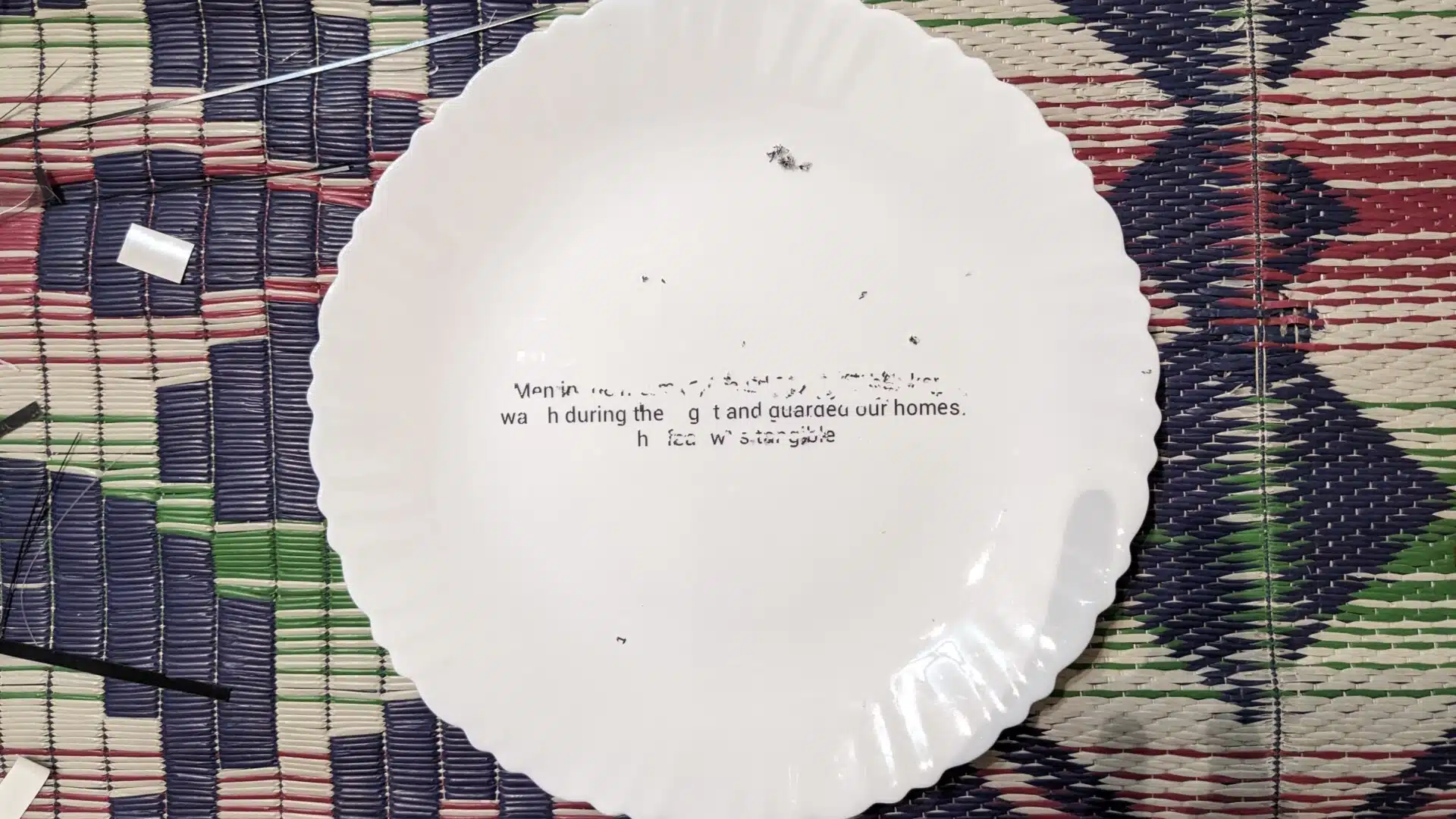
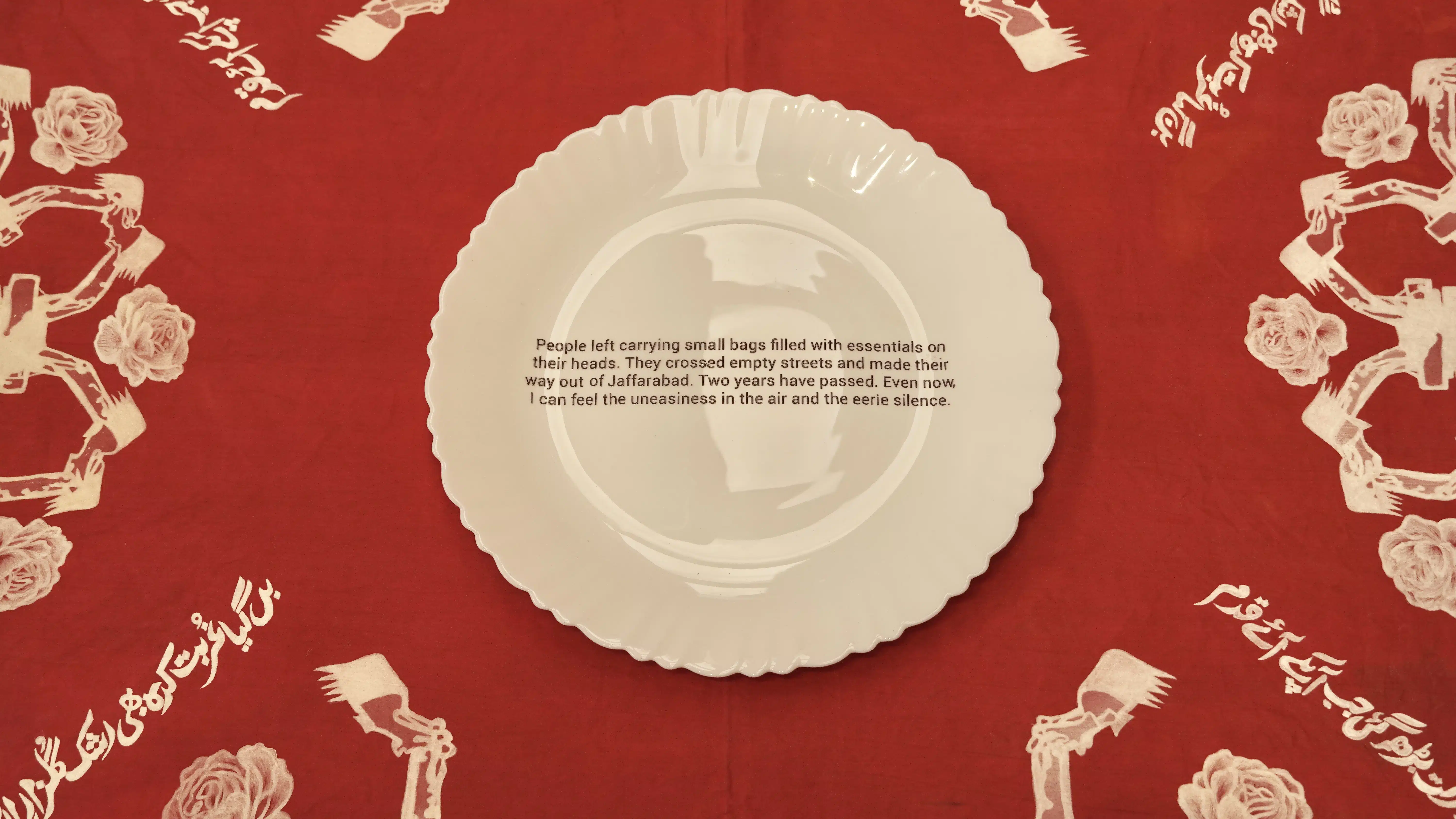
Primarily invested in questions of memory, identity, and belonging within the framework of South Asian domestic life, Afza’s practice brings the personal into uneasy proximity with histories of violence. Her works move between family albums, news and media archives, and everyday household textiles such as the dastarkhwaan—the dining cloth traditionally laid on the floor—treating them as sites of ritual, intimacy, and collective remembrance. What emerges is a visual language where tenderness and rupture co-exist.
Afza’s sensibility is shaped by place. Growing up in Bihar Sharif and later spending formative years in Jamia Nagar, New Delhi, she developed an acute awareness of how memory, community, and routine anchor everyday life. Her move to Hyderabad—with its layered histories, architecture shaped by Islamic traditionsx, food cultures, and unhurried pace—has further deepened this attention to domestic spaces and small rituals. Streets, homes, and objects become repositories of lived history rather than backdrops. Textiles occupy a central place in her work, rooted in family memory. Her family has been involved in the weaving and clothing trade for generations. “As a child, I watched my mother and her sisters stitch together leftover pieces of coffin cloth from my grandfather’s shop, turning them into tablecloths, pillowcases, and curtains. They traced delicate floral patterns on white fragments and embroidered them by hand,” she recalls. This transformation—cloth associated with death becoming a surface of care and beauty—sits at the core of her practice. Working with fabric allows Afza to honour childhood memory while confronting the discomfort embedded within material histories.
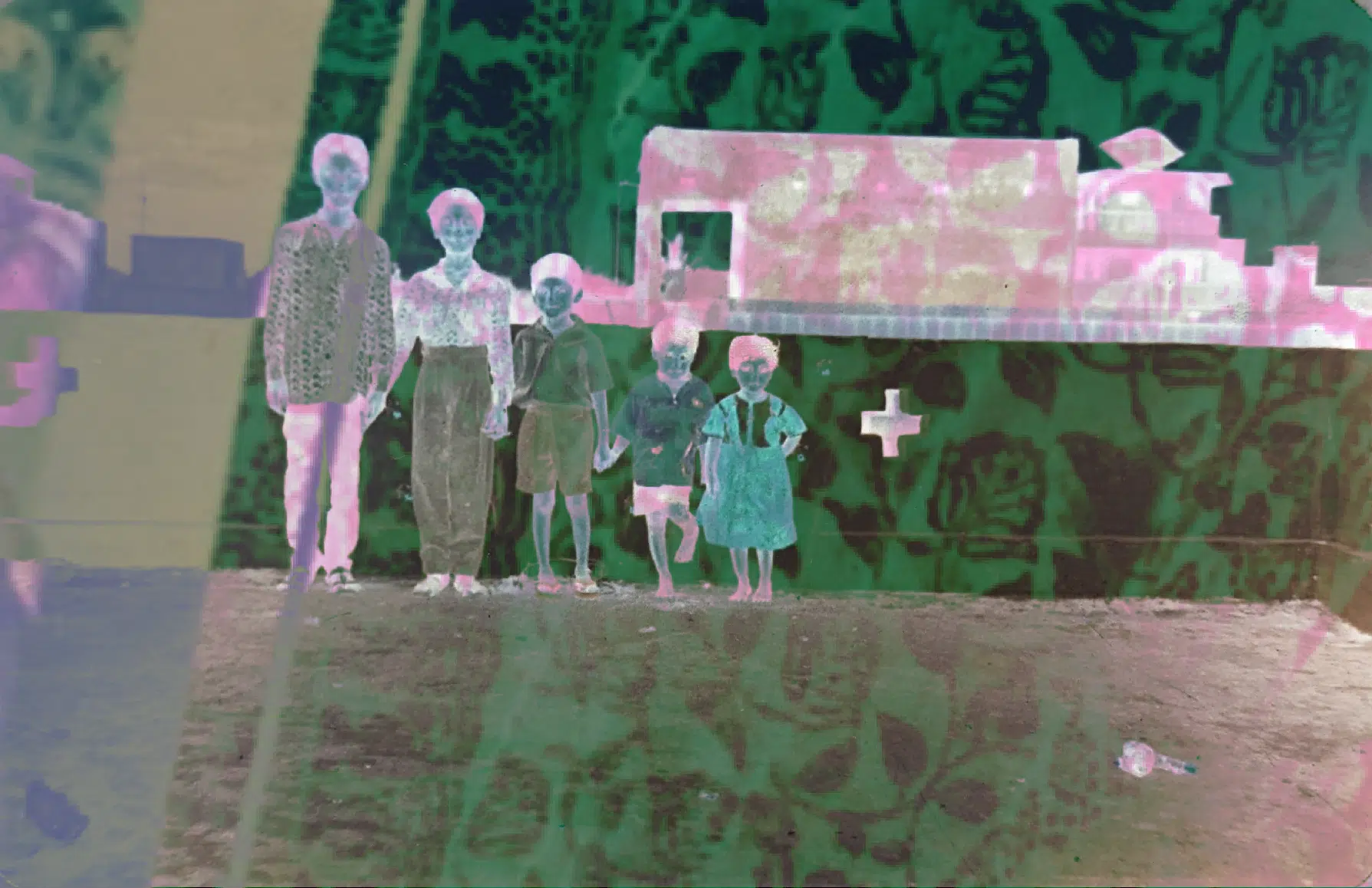
Her method is archival and reflective. Afza closely studies family photographs and documents, reading them against broader social contexts to uncover layered meanings. “A reflective practice has enriched my art and enabled me to tell the stories that I want,” she writes. Her influences range from Islamic geometric patterns found in iron gates, windows, and balconies of older neighbourhoods, to the saturated colour palettes of urban margins, and the works of artists such as Taysir Batniji, Zarina Hashmi, Walid Raad, and Zineb Sedira. Films, books, and podcasts further feed her visual thinking.
“My favorite places to look at art aren’t galleries but the streets, especially in the older parts of the city,” she notes, pointing to an everyday visual education grounded in observation rather than institutions.
Afza allows narrative to determine medium. A pivotal shift in her practice came when she began juxtaposing disturbing news imagery with photographs from her personal archive. She layers family images and architectural motifs into kaleidoscopic compositions built from fragments of violence. From a distance, her works appear intricate and ornamental; up close, they reveal unsettling, often gory details. Maintaining this tension requires care. “I honor the intimacy of domestic archives and family rituals, allowing them to hold their own space and warmth,” she explains, even as harsher histories press in.
DOWNLOAD A SPECIAL ARTIST POSTER >
As an Artist-in-Residence at India Art Fair 2026, Afza is developing three interconnected projects. One extends her dastarkhwaan series, incorporating block-print–like repetitions drawn from early-2000s incidents of communal violence, using monotony and pattern to evoke exhaustion and unease. Another is a video work that transforms archival images of a historic demolished structure into shifting kaleidoscopic forms. The third is an installation inspired by the taakh—a small arched niche found in many traditional homes—which she enlarges and centres as a space for reflection. Speaking about the residency, she notes, “It has revealed deeper social histories embedded in everyday domestic objects and family archives, aligned with themes of violence and resilience.”
Farhin Afza was born in Bihar Sharif and currently lives in Hyderabad. She is an Artist-in-Residence at India Art Fair 2026, where her final works will be unveiled during the fair from 5–8 February.